Posts

Showing posts from 2018

Observability of the Java Virtual Machine

Image
The JVM is one of the most observable runtimes. It provides us lots of tools for troubleshooting a JVM application in production. 1. Thread observability Threads are how the JVM actually does work. When something is wrong in production, the symptom is almost always a thread: stopped, blocked, leaking etc. Thread dumps work on any JVM with no  instrumentation, no agents, no restarts. <Example project link with /threaddump endpoint>         // (1) Deadlock — two threads grab the same pair of locks in opposite order.         new Thread(() -> grab(LOCK_A, LOCK_B), "deadlock-A-then-B").start();         new Thread(() -> grab(LOCK_B, LOCK_A), "deadlock-B-then-A").start(); http://localhost:8080/actuator/threaddump To list the JVMS, we can use the command below. PS C:\observe-jvm> jps -lv 25296 jdk.jcmd/sun.tools.jps.Jps -Dapplication.home=C:\Program Files\Microsoft\jdk-21.0.3.9-hotspot -Xms8m -Djdk.module.main=...
A* Search Algorithm and Priority Queues

Image
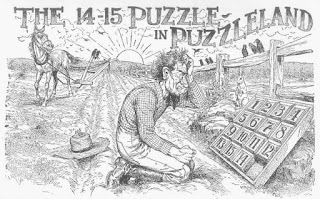
In this blog post, I'll examine the fifteen-puzzle problem . We have an n x n grid filled with numbers from 1 to n-1. Our aim is to reach the position called the "goal board." For example, for a 3x3 grid, our goal board is: 1  2  3 4  5  6 7  8 To reach there, we will be sliding blocks horizontally and vertically to the blank square. The solution approach to this problem utilizes the A* search algorithm . These kinds of algorithms use heuristics to arrive better positions. Let's explain the steps of the algorithm: Create a priority queue and enqueue the initial position. Dequeue the best item using the heuristics. Insert all neighbours of the dequeued item into the queue. Repeat this procedure until the goal board is dequeued.  For each position we need to calculate the heuristic function. For this problem, we can use one of the two priority fuctions: 1) Hamming priority function: The number of blocks in the wrong position. 2) Manh...

A Pattern Recognition Problem: Finding Line Segments Effectively In Java

Lets say we are given a set of  n  points and we need to find every line segment that connects 4 or more of the points. We have an immutable data type for Point: public class Point implements Comparable {     private final int x;        private final int y;        //...     public int compareTo(Point that) {         if (that.y == y && that.x == x) {             return 0;         }         if (y < that.y) {             return -1;         }         if (y > that.y) {             return 1;         }         if (x < that.x) {             return -1;         }         // ...

Dynamic Connectivity Problem and the Union-Find Algorithm

Lets say we need to connect some objects and query if some objects are connected or not. Below is an example test: @Test     public void testConnectivity() {         MyConnectionDb connectDb = new MyConnectionDb();         connectDb.connect(4, 3);         connectDb.connect(3, 8);         connectDb.connect(6, 5);         connectDb.connect(9, 4);         connectDb.connect(2, 1);         assertTrue(connectDb.isConnected(8, 9));         assertFalse(connectDb.isConnected(5, 4));         connectDb.connect(5, 0);         connectDb.connect(7, 2);         connectDb.connect(6, 1);         connectDb.connect(7, 3);         assertTrue(connectDb.isConnected(5, 3));     } So whe...

Popular posts from this blog

The WeakReference class, monitoring memory leak and garbage collection in a Java application

Simplescalar Simulator - Part 2: sim-outorder.c

Notes on Java Performance